Sustainable Business Development
Mapping materialities through risks and converting them into opportunities is not only the basis for our dual materiality analysis, but also the path to sustainable business development.
In our impact/risk/opportunity analysis (IRO analysis), we have assessed risks linked to human rights and OECD standards, so that we can create new opportunities within the green transition, social sustainability or management governance.
Strategy
Give Steel wants to use our strategy to become project owners’ preferred choice. ESG is our leverage to achieve this position. Give Steel is purpose-driven, so our business strategy also stands on the foundation of our approach to people.
The strategy’s action plans aim for increased exports and cover a number of themes related to ESG: Environment (E), Social Sustainability (S) and Good Governance (G).
Because of our augmented sustainability, dialogue and documentation requirements, Give Steel has the opportunity to influence projects towards greater sustainability and help the customer make more sustainable choices. But this also requires us to think harder across our value chain, job functions, departments and geographic situation.
Risks and Opportunities
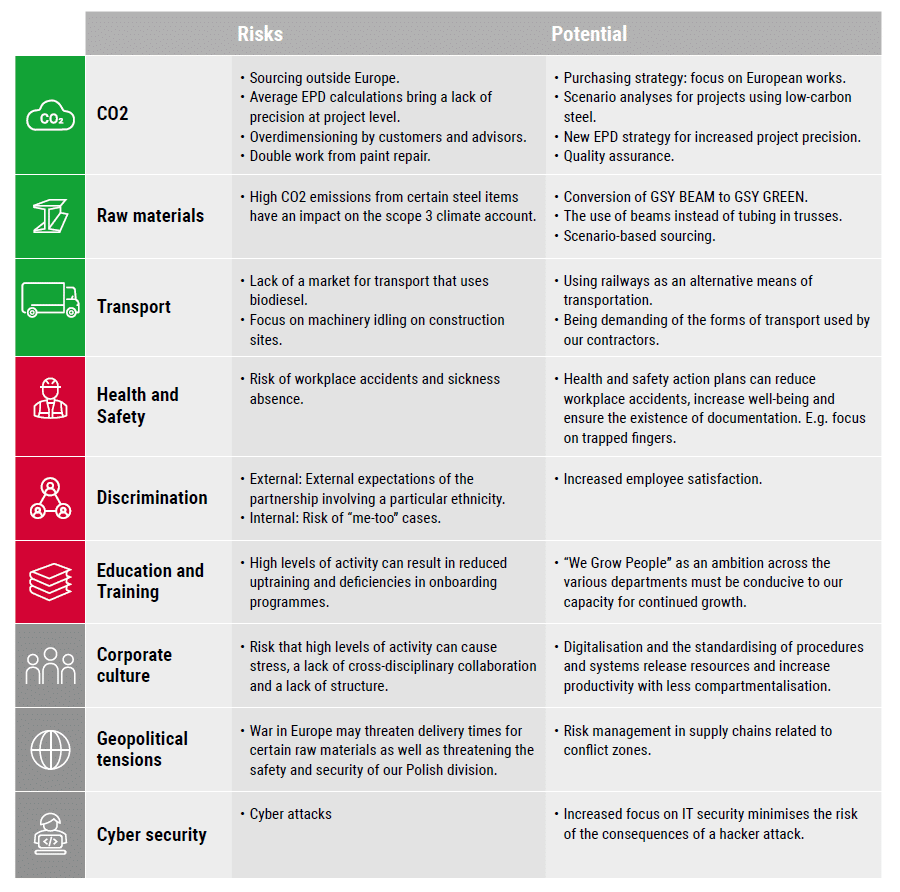
Our IRO analysis (impact, risk, opportunity ) transforms challenges into opportunities that can be launched or investigated as potential action plans as part of the company’s sustainable business development.
The chart we have compiled to accompany this text maps out the themes that were analysed in Give Steel’s Double Materiality Assesment.
The nine themes presented on the chart are the themes that scored highest in a broader overall Double Materiality Assesment.
We have taken each risk as a point of departure and tried to turn them into value-creating solutions so we can use our analysis to create sustainable business development.