What is low-carbon steel actually?
The EU does not yet have an official definition of what low-carbon steel actually is. Low-carbon steel is therefore used thus far as a joint designation for the steel elements on the market with the lowest CO2 emissions when compared with conventional steel. CO2 emissions can vary greatly by production method, depending on which steel elements are involved.
The market is in a constant state of development, which means that the European steel rolling mills we choose to work with when buying low-carbon steel will vary.
When you place an order with Give Steel for a low-carbon steel structure, we will analyse the CO2 figures for the raw materials currently available on the market (CO2 scenario analysis) and use their findings to select the raw materials that are best suited for your specific project. CO2 figures, price and delivery time are important parameters in this regard.
Choose CO2-reduced steel and reduce emissions
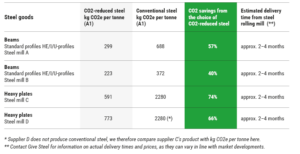
The choice of steel is highly significant for the overall climate impact of the construction, especially in the product stage (A1–A3). Experience from Give Steels projects shows that substitution with CO2-reduced steel can usually reduce CO2 emissions by up to about 40%. CO2-reduced steel covers steel goods with documented lower carbon footprint that corresponding conventional alternatives, based on available EPD data.
The EU CSRD directive requires “chain responsibility” and therefore requires close dialogue and collaboration about raw materials choices, involving project owners, Give Steel as supplier and the wholesalers and steelworks we work with.
Give Steel works alongside our suppliers to obtain the necessary CO2 documentation. Low-carbon steel achieves its low CO2 value because of the quantity of recycled steel scrap it contains and because the steel is produced using only renewable energy.
Low-carbon EPD calculations
Because our purchases of low-carbon steel are customised to each individual project, the works will supply an EPD for the raw material upon request. Collecting EPDs for the individual steel elements means that we can add the documented CO2 from our own production and transport, thus documenting the CO2 footprint of each steel structure much more accurately than is possible by using calculated averages in our own general EPD.
Early involvement will reduce a steel structure’s climate impact
Some types of steel can be associated with longer delivery times. It is therefore essential that you involve Give Steel in your construction project as early as possible so that get the CO2 figures as low as possible while still being able to source the raw materials on time.
The table below shows examples of CO2-reduced steel blanks and their CO2 emissions when compared to conventional alternatives, as well as rough delivery time estimates, based on the situation at the beginning of 2025.