CO2 savings through design optimisation
Structural principles that lower the CO2 footprint of steel structures.
Structural design offers great opportunities for the CO2 optimisation of steel structures. A well-thought-out design can save project owners significant amounts of CO2 to the construction’s carbon accounting. This simply requires the early involvement of Give Steel as a supplier – along with close collaboration between project partners.
Make the most of the strength of steel
Many parameters come into play when optimising a building’s structural design. These range from the building’s span width and height to its geographical location relative to applicable wind impact standards. From a structural perspective, this means making the most of the strength of steel in the building’s design, so as to minimise the tonnage of the specific building structure.
The many technical factors involved make CO2 reduction a complex engineering task that often requires steel specialists who have specific experience in this particular discipline. This is why Give Steel’s engineers work closely with both advisors and project owners to ensure the most climate-friendly construction principles possible. Our experienced sales engineers, BIM designers and structural engineers are all trained in utilising the strength of steel optimally. This creates significant CO2 savings on both simple steel structures and more complex structures. In the process, the use of advanced software goes hand in hand with the engineers’ innovative thinking and alternative design solutions, ensuring maximum utilisation of the steel’s properties
Exampel 1:
Replacing raw material components in steel truss design
H-profiles increase the weight of a truss but reduce its CO2 footprint. The diagonals of a lattice truss are typically made using hollow sections. However, they can also be designed with H-profiles, which generally have a significantly higher content of recycled steel. This reduces the CO2 impact of the overall structure – even though it usually requires more steel than when using hollow sections. From a production perspective, a truss featuring H-profiles will be more complex to produce, which may increase production costs Notably, the CO2 footprint of the steel structure in this case is not solely determined by its tonnage.

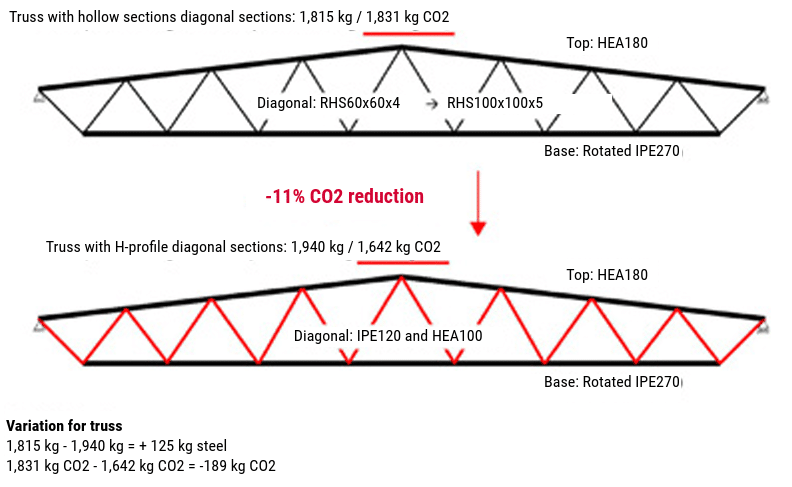
Illustration 1: Trusses with H-profile diagonals increase tonnage, but minimise CO2 footprint when compared to classic trusses with hollow sections. In this example, we reduced the CO2 footprint by 11% despite the increased tonnage.
Exampel 2:
Conversion from standard profile to a welded profile meant CO2 savings of 51%
Another form of design optimisation can be achieved by replacing standard profiles with welded profiles. This maintains the building’s external profile of the building, while allowing plate body thickness to be significantly reduced. The flange size can also be reduced slightly. In practice, this means that thinner plates are welded together, compared to the plate thickness of standard profiles. This reduces both tonnage and CO2 footprint when using Give Steel’s EPD.


Illustration 2: An example of a hall building that was originally designed to use standard profiles. Our engineers optimised the structure on the basis of the same assumptions that served as the basis for the consultant’s diagrams. Instead of using standard profiles as a raw material for the steel structure, profiles can instead be custom designed by welding plates together to achieve narrower thickness, thus saving CO2.
Exampel 3:
Welded beams
The use of welded steel frames is a classic example of CO2 optimisation. The principle has been used for many years in simple constructions to reduce tonnage (and thus costs). Nowadays, CO2 savings are also an important argument to support the use of welded structure principles.


Illustration 3: The illustration above presents a classic “before and after” image of what happens if we switch from a steel frame designed with standard profiles to welded, wedge-shaped structures that position the steel where it is most effective. This allows for significant reductions in tonnage, which obviously also reduces the overall CO2 footprint.